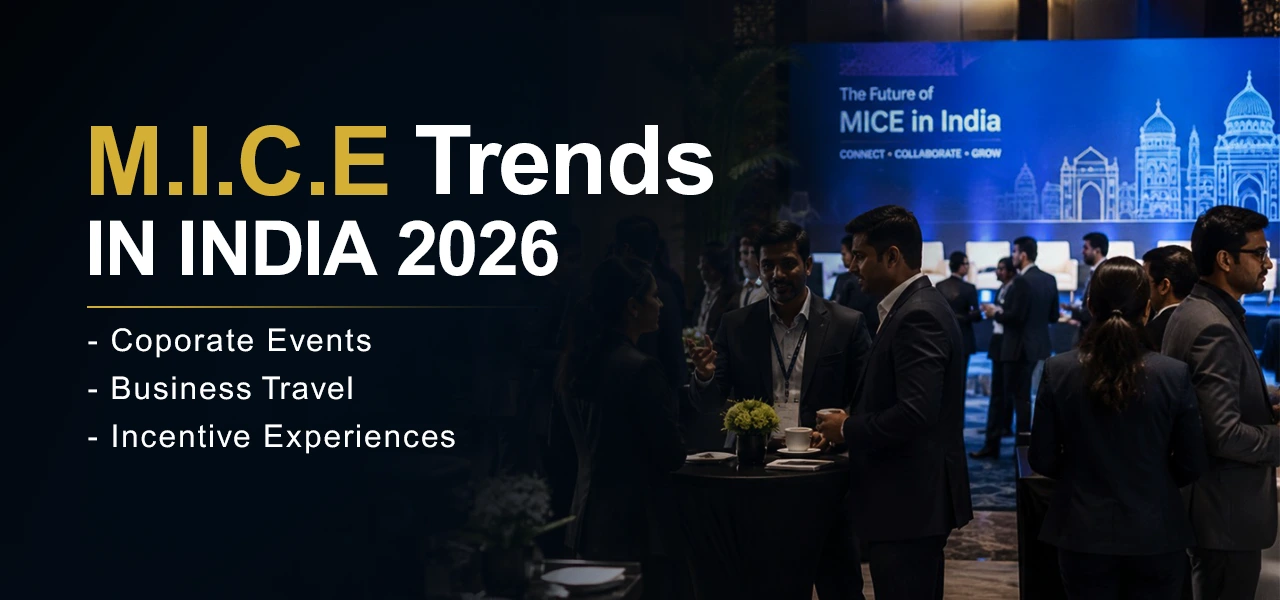
MICE Trends in India 2026: Corporate Event, Meeting & Business Travel Trends
Corporate events in India have changed more in the last three years than in the decade
before that. The shift isn't about formats or venues — it's about what companies expect
their events to actually deliver. Attendance was once the primary measure of success.
Now organisations want to know what their people experienced, what business
conversations happened, and whether the investment created any lasting impact.
That shift is reshaping how MICE Events in India — Meetings, Incentives, Conferences
and Exhibitions — are being planned. Companies that understood MICE purely as
logistics are now thinking about it as a strategic investment in their people and their
business relationships,
This article covers what is genuinely changing, why it matters to companies planning
events in India, and what planning teams should be thinking about before they brief a
vendor or book a venue.
What Is Changing in India's MICE Landscape?
The corporate event market in India has grown substantially, and with that growth has
come higher expectations. Companies are no longer satisfied with an event that simply
runs without incident. The bar for what constitutes a successful MICE programme has
moved — and it has moved because employees, leadership teams and clients have
attended better events and now know what good looks like.
A conference that fills a hotel ballroom with PowerPoint presentations and a buffet
dinner is no longer a default benchmark. Companies want events where people are
engaged, where the destination adds value, where the agenda leaves room to breathe,
and where the business objective is actually met — not just referenced in the opening
speech.
The companies planning well right now are doing so by working backwards from a clear
outcome rather than forwards from a budget line and a venue shortlist.
Major MICE Trends in India
1. Experience Has Become the Headline, Not the Agenda
The programme inside the room still matters — but companies have started to
recognise that how attendees feel about an event is shaped as much by the
surrounding experience as by the sessions themselves. Venue atmosphere, quality of
food and hospitality, quality of accommodation, and what happens in the hours between
structured sessions all contribute to whether people leave feeling that the event was
worth their time.
For conferences and incentive programmes alike, this means the venue brief now
includes questions about networking spaces, outdoor areas, quality of local restaurants,
and travel time from the airport — not just room capacity and projector specs. A venue
that works beautifully on paper but involves a three-hour transfer from the airport is
going to lose goodwill before the event even starts.
2. Personalisation Is Moving From Nice-to-Have to Expected
Large
Corporate Events in India have traditionally been planned around a single
programme for everyone. That's becoming harder to justify when a group includes
senior leadership, mid-level managers, international delegates, and first-time attendees
— all of whom have different expectations and different reasons for being there
Personalisation doesn't require a different event for every attendee. It means building
enough flexibility into the agenda that people can choose experiences relevant to them
— breakout sessions aligned to specific roles, optional excursions that suit different
interests, networking formats that don't force every conversation into a single room at
the same time. Even small choices — dietary preferences managed properly, a
personalised welcome pack — signal that the company has thought about the
individual, not just the headcount.
3. Destination Selection Is Being Treated as a Strategic Decision
Destination choice used to come down to cost, availability and familiarity. That's still
relevant, but companies are now asking a more useful question: does this destination
make the programme better?
A destination that gives attendees something they genuinely can't experience in their
home city — a different cultural context, access to nature, a distinctive hospitality style
— adds value to the MICE investment in a way that a generic business hotel in a
familiar city doesn't. Goa, Coorg, Udaipur, Jaisalmer, and several hill destinations
across South India are seeing more corporate interest precisely because they offer that
context. But the selection logic still needs to account for travel time, visa requirements
for international groups, hotel room inventory, and whether the local infrastructure can
support the technical requirements of the programme.
The destination has to earn its place in the brief — not just look good in the event
proposal
4. Technology That Solves a Real Problem
Event technology has expanded significantly, and there's now a temptation to use it
because it's available rather than because it makes the experience better. Digital
registration, attendee apps, live polling, real-time feedback tools and hybrid streaming
capabilities are all genuinely useful in the right context. The question for any
MICE Event Planning team is a simple one: what problem does this technology solve for the
attendee?
An event app that helps attendees navigate a multi-track conference, access speaker
materials, and manage their own schedule solves a real problem. A live polling tool that
replaces audience participation in a panel discussion and surfaces useful data for the
organiser solves a real problem. An augmented reality installation added because it
looks impressive in the event brief — usually doesn't.
Technology also creates its own logistics. Every digital element requires testing, support
staff, backup systems, and user briefing. Factor that into the planning timeline rather
than treating tech as a plug-and-play add-on.
5. Sustainability Is Entering the Planning Brief
Sustainability in MICE planning has moved past token gestures. Companies with
established ESG commitments are now applying those standards to their event
planning — which means venue selection includes questions about energy sourcing,
waste management and local supply chains.
In practical terms, this looks like: choosing venues with genuine sustainability
credentials rather than just a brochure claim, reducing single-use plastics in catering
and branded materials, sourcing food locally where possible, and designing event
transport to reduce unnecessary vehicle movement. Reusable signage and backdrops
rather than single-use print materials is another area where the shift is visible.
This isn't about making the event a sustainability statement. It's about aligning the event
production with standards the company already holds itself to in other areas of the
business.
6. Wellbeing Has a Seat at the Incentive Table
Incentive programmes and corporate offsites in India are increasingly building in time for
people to actually rest. A packed itinerary that runs from 7 AM briefings to midnight
dinners might look comprehensive in a proposal, but it doesn't leave participants in a
good state to engage with the content or each other.
Employee Engagement Events
that include structured downtime — a free afternoon, optional wellness activities,
unscheduled evenings — consistently produce better feedback than those that fill every
hour.
This isn't a wellness trend. It's a recognition that people perform better when they're not
exhausted, and that an event's purpose — building relationships, generating business
ideas, rewarding performance — is better served by a well-paced programme than an
overstuffed one.
7. Smaller Gatherings Are Producing Better Results
Not every business objective requires a large conference. Leadership retreats, strategic
offsites, focused sales kickoffs, and high-value incentive trips for smaller groups are
areas where
Corporate Event Planning teams are seeing stronger outcomes per head
than larger events produce
A smaller group in the right setting creates more genuine interaction. Conversations go
deeper. Networking happens organically rather than through structured sessions.
Decision-makers spend time together in a context that produces real outcomes. The
logistics are also more manageable, which means the execution is often tighter.
Large conferences still serve a purpose — particularly for industry visibility and largescale communication. But companies are increasingly separating their MICE calendar
into different formats for different objectives, rather than defaulting to one large annual
event for everything.
8. Success Metrics Are Getting More Specific
Attendance numbers and post-event satisfaction scores are still collected, but they're no
longer the only measure companies care about. Event ROI is being tied more directly to
business outcomes: how many qualified conversations were generated at a conference,
what decisions were reached at an offsite, how the incentive programme affected
retention or sales performance in the following quarter.
This requires defining success before the event is planned, not after it concludes. When
the objective is clear — close a specific number of partnerships, align a leadership team
on a strategic direction, reward the top 20% of a sales team — it becomes much easier
to design an event that can actually deliver it and measure whether it did.
What These Trends Mean for Corporate Event Planning
Taken together, these shifts point in one direction: MICE programmes in India are being
held to a higher standard, and the planning process needs to reflect that.
Companies that plan
Corporate Meetings and Conferences the same way they did
five years ago — venue first, agenda second, experience as an afterthought — are
producing events that don't land the way they once did. The expectations of attendees
have changed, and the planning approach needs to keep pace.
That doesn't mean spending more. It means spending differently — and planning
earlier. Most of the improvements companies are seeing in their MICE programmes
come from having more time to make better decisions about destination, experience
design, and vendor selection rather than from larger budgets.
How to Choose the Right MICE Approach
Before briefing any event company or venue, work through these questions:
- What is the specific business objective? How will you know if the event achieved it?
- Who is the audience? What do they expect from this type of event?
- What is the group size? Does the chosen format suit the number of attendees?
- How much travel time can the audience realistically absorb? Will the journey affect their overall experience?
- What is the right balance between structured programming and free time? Does the schedule give attendees enough room to engage and recharge?
- What does the destination offer beyond the event venue itself? Does it add meaningful value to the overall experience?
- What does success look like 30 days after the event? Which outcomes will demonstrate that the programme delivered its intended value?
These questions don't have universal answers. A 50-person leadership offsite needs a fundamentally different approach from a 500-person annual conference. An incentive trip for a high-performing sales team requires different experience design from a client-facing industry conference.
The planning logic should follow the objective and the audience — not the other way around.
A Practical Perspective
MICE programmes in India have a genuine opportunity to deliver more than they have
historically — not because event technology has improved or new destinations have
opened up, but because companies are now asking better questions before they start
planning.
The most effective MICE programmes — regardless of scale, budget or destination —
share one characteristic: they were designed around a clear purpose and a real
understanding of the people attending. Everything else follows from that.
The trends covered in this article are worth understanding, but none of them should be
adopted simply because they're current.
Incentive Travel in India works best when the
experience is chosen for the audience and the outcome — not for the proposal
document.
How Erigo Events Supports MICE and Corporate Event Planning
Erigo Events manages
MICE Events and corporate programmes end to end — from
concept development and destination selection through to on-ground execution and
post-event documentation. Our work spans conferences, incentive programmes,
corporate offsites, annual days, team engagement events, and exhibitions across India.
We also manage related programmes including
Team Building Activities and
Corporate Family Day Events for companies looking to build a broader employee
experience calendar.
If you're planning a MICE programme or corporate event and want a team that
understands both the planning complexity and the experience design side of what
makes these events work, we're happy to start with your brief.
Contact Erigo Events :
www.erigoevent.com